

Feature
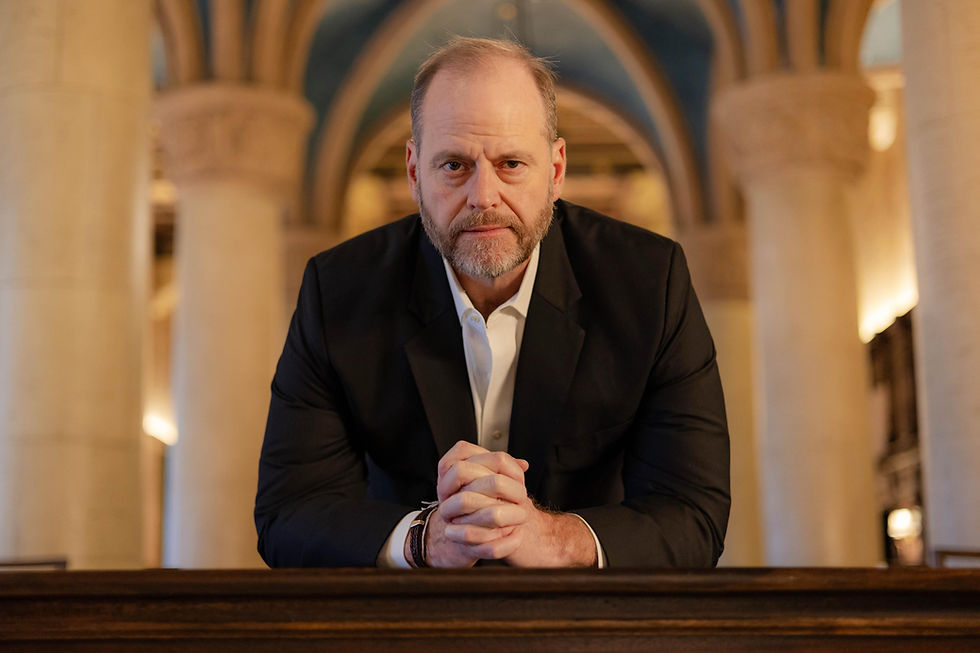
Author Forrest Jones on Writing What He Knows
Seasoned Miami reporter Forrest Jones spins his late 1990s years covering Venezuela into the gripping (and prescient) geopolitical thriller, "The Placebo Agenda."
by Shawn Macomber
Like this article? Share it with your friends!
In the mid-1990s, Forrest Jones moved to Venezuela to teach English and hone his Spanish. “Things were good, but I wanted more from my time abroad,” he tells AQUA Miami. And boy did he ever get it: After cold calling an English-language daily newspaper called The Daily Journal, he landed a primo gig as International Editor, “letting expats across the country know what was going on around the world.” And this was how one afternoon in 1997, Jones found himself seated across from a long-shot presidential candidate detailing what he would deliver “to a population that had grown weary of the economic fallout from a banking crisis a couple of years earlier.”
His host—one Hugo Chavez—would win a shocking electoral victory on Dec. 6, 1998.
Putting in the Work
Jones continued to work as a reporter for the next few years in Chile and Colombia, before returning to the United States one month before the Sept. 11, 2001, terrorist attacks. He earned his MBA in International Business from the Thunderbird School of Global Management. (“Though grinding through debits, credits and financial engineering on Excel sheets was new,” he says, “coursework on the IMF and political players was not.”) Eventually, he landed at Latin Trade magazine in Coral Gables. To scratch an increasingly insistent itch to write fiction, he also joined a writing group at FIU run by the award-winning author John Dufresne.
The camaraderie and craft paid off. Suddenly, the many seemingly disparate strands of his professional life and personal passions wove together, and Jones’ debut novel—a pulse-pounding, keep-you-guessing-till-the-final-page geopolitical thriller, "The Placebo Agenda"—took form.
“The idea came from a news item I saw in which a U.S. diplomat in Bolivia asked a Fulbright Scholar and Peace Corps volunteers to keep tabs on Venezuelans and Cubans in the country, which violated U.S. policy,” Jones explains. “I won’t give it away, but things are happening in real life that reflect what went on in my book—such as major powers quietly maneuvering around Venezuela’s instability and trying to turn that chaos to their advantage.” Almost spooky prescient and timely, no?
The protagonist—a Miami reporter colorfully named Street Brewer who takes on powerful corporate and political interests armed with little more than his wits and an old school newspaperman’s tenacity—is, as you will see, at least in part born of the foundational maxim write what you know.
The Real Venezuela
So, what did Jones learn about Venezuela during his time there? Well, first and foremost, Venezuela is extraordinarily rich in resources—both natural and human.
“Most people know [Venezuela] has oil, but few realize it holds the largest proven reserves on earth—more than any other country,” he explains. “Much of it is heavy crude, but for years it flowed to U.S. refineries designed to handle it.” Beyond oil, there are vast reserves of not only natural gas, but also gold, copper, nickel, zinc, iron ore, bauxite, diamonds, coal, forests, as well as immense rivers capable of generating enormous hydroelectric power. “Of course, there’s also the famous Miss Venezuela contestants and a string of top-tier baseball players,” Jones adds.
And while crime, corruption, and poverty remain persistent, real problems—alongside “the centuries of very strong presidents, caudillos, a few dictators and Simón Bolivar, the man who liberated Venezuela, Colombia, Ecuador, and Peru from Spain, then declared himself president for life,” Jones notes—the people are an amazing untapped resource in their own right. “What most people don’t know is how resourceful the Venezuelan people can be,” Jones says. “I worked with them for almost four years. Their ingenuity and problem-solving capacities are second to none. They are extremely tech-savvy and clever. In the face of crisis, they remain calm. In the face of opportunity, they find new and innovative ways to seize it. They are open, warm, and inviting. I’m looking forward to going back one day for a long visit.”
Meeting Chavez
Jones will never forget that day. Chávez was living in a nice apartment with several bedrooms and a balcony with a decent view just outside of Caracas. An assistant showed Jones in, Chavez arrived soon after. The two men shook hands and got down to business.
“I was kind of new at the newspaper,” Jones says. “While I was learning journalism and the art of interviewing someone important and drilling for the truth behind every word, he was learning governance and the art of politics, the art of spinning every word for his agenda…I remember him during the campaign as a firebrand at times, but not mentally unstable or anything like that, while I was in Venezuela. Everyone remembers his bombastic antics at the U.N. General Assembly and his unnerving comments and actions years later, but he was very friendly that day. His daughter came in afterwards and gave him a big hug.”
In normal times, Chavez would likely not have stood a chance. But 1998 was perfect storm territory. “Basically, the two established political parties at the time, Copei and Acción Democrática, were very unpopular due to economic mismanagement and a corruption case behind former President Carlos Andrés Pérez, who Chávez sought to oust in a coup five years earlier,” Jones says. “Irene Saez, a former Miss Universe, led in the polls. Though she aligned with Copei during her race to Miraflores, she maintained her position as an outsider. Henrique Salas Römer, also an outsider, would be the one to challenge Chávez from his own homegrown political organization, Proyecto Carabobo. Chávez launched his own political party—the Movement of the Fifth Republic—and branded himself as the quintessential outsider, the champion of the poor and crusader against corruption and savage neoliberalism.” Jones asked Chavez how, in a lineup of outsider candidates, what could he and only he deliver to the people? “I’ll never forget his answer: un país distinto,” Jones says. “A completely different country.”
Chavez even got comfortable enough with Jones—despite their very different economic and political philosophies—to discuss his failed coup.
“He pulled out a map and told me what went down that night in a much softer voice than his usual tone,” Jones recalls. “The president was flying back into Venezuela from Switzerland. His men were in position, but a leak foiled the plot. I’m from the U.S., I hold an M.B.A., and I espouse neoliberal economic policies. But that day, I asked about a coup attempt from the man who led it. He was sitting right next to me, in his home, telling me what went down on that fateful night. That’s a memory I’ll take with me forever.”
Chaos Agent
The economic and political turmoil of the last decade didn’t surprise Jones. “Chávez knew how to play the game at first,” Jones says. “My bureau chief at the time caught him meeting secretly with Wall Street bondholders to assure them he would pay Venezuela’s debt just after he was elected. But eventually, he started going downhill. Maduro took the country’s reins and amped up extrajudicial jailings and disastrous economic policies. And documented stories of the country acting as a springboard for drug smugglers go back for years.”
One thing that did surprise Jones? The recent capture of Maduro by U.S. military forces. “While he won’t be missed, what’s next?” he says. “Now that the world is focusing on Iran, will Maduro’s team continue running the show? There are still lots of questions out there.”
For Jones, what the future holds for Venezuela and its expat community here and elsewhere all comes down to what lessons are taken from the past. For example, when Jones tells Venezuelan expats he lived in-country from 1995 to early 1999, they always say he was there during the good years.
“They were not good times at all, though,” he says. “It was the biggest Black Swan event I’ve ever seen. Chavismo is arguably the product of reckless capitalism. In 1994, Banco Latino collapsed after reckless lending amid weak oversight, sparking a banking crisis. The country was then forced to go to the International Monetary Fund (IMF) for assistance, and the multilateral lending institution bailed out the country in exchange for austerity measures needed to right the economy. As a result of letting the currency float and other measures, inflation shot up and the nation suffered.
“When I lived there in 1996, I was earning local currency—and very little of it—when inflation hit 103 percent,” he continues. “I felt the pain firsthand. By 1997, economic indicators pointed to a country on the mend, but by 1998, the Asian financial crisis sent global crude prices tumbling, with a Venezuelan barrel dipping to a paltry $8 a barrel at one point. By then, the people had had enough of feeling all the effects of recessions but none of the fruits of expansion. They had enough of crime, enough of corruption and overwhelmingly voted in Chávez, who ultimately sent the country careening in the wrong direction. The lesson here is a return to pre-1998 Venezuela is not the way to go. A new framework that doesn’t rely on a super-strong president might be in order. Setting up new cities outside of Caracas, developing non-oil sectors like manufacturing followed by services and technology, should be under review as well I don’t know. I am not an economist. I do know that dreaming of a past that never existed may doom the country to repeat one that did.”
As for Jones, he’s moving forward as well: He just finished my second novel, Uncovered.
“It features my same protagonist from The Placebo Agenda, Street Brewer, who travels to a land where I also lived—Saudi Arabia,” he says. “I worked for Saudi Aramco as a writer/editor in the environmental protection unit from 2015 to 2019. In my new novel, Street must track down a renegade Saudi prince who’s launching a string of cyberattacks against the U.S.”
Never a dull moment in the world of fictional intrigue.
For more information visit contentbyforrest.com.